When spec pay-ups shift, a lender has a window and a cost. Pass through too little and a lender prices themself out of the loan. Pass through too much and margin is left on the table. And because a spec pay-up drop rarely announces itself, the loss is often not seen until month-end.
The March 2026 spec pay-up drop-off is a clear example of how fast that window can close.
March 2026 is a good example of how fast spec pay-ups can move. The signal was in the data as it happened and the lenders watching repriced quickly and captured the margin while the window was open.
In this post, Sarah Hellman, Director of Lender Analytics at MCT, explains how spec pay-ups flow through to borrower pricing, what the March 2026 drop meant, where lenders get caught off guard, and how spec data from Lender Analytics Advanced helps capital markets teams respond before the damage shows up on a P&L.

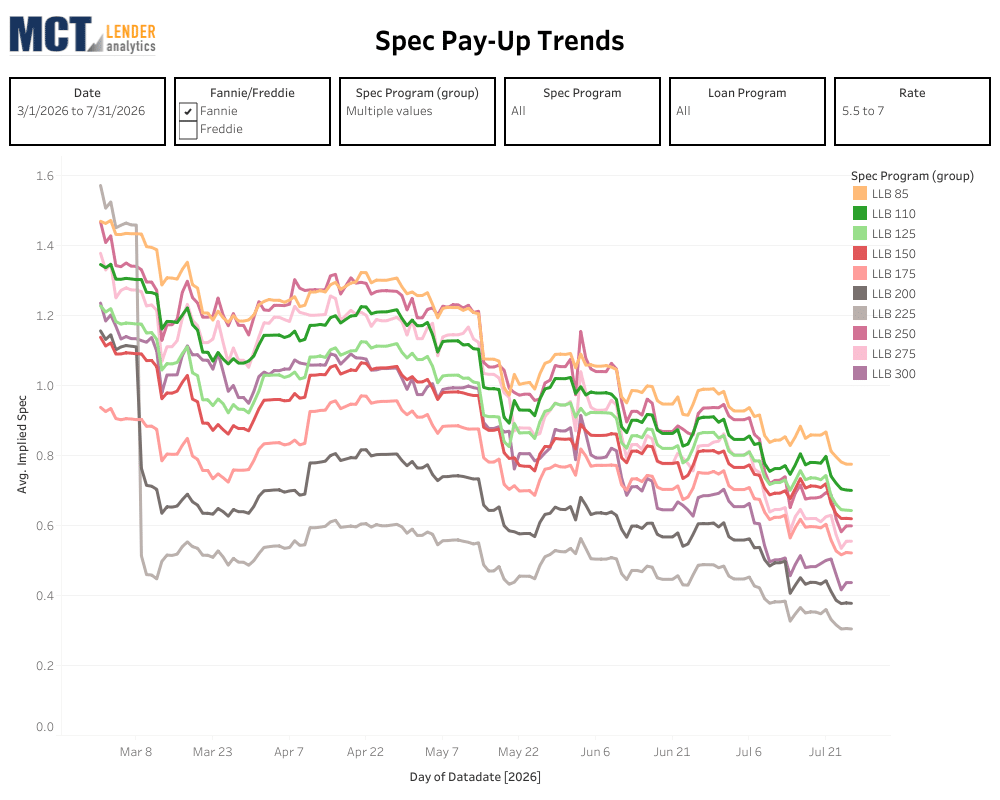
The graph above shows proprietary MCT data looking at implied spec values. It shows LLB pay-ups have given back 0.50 to 0.70 in implied value since late August 2026 through September 2026.
Table of Contents:
What the Spec Pay-up Drop in March Meant for Borrower Pricing
March 2026 delivered a sharp reminder of how quickly these premiums can move.
Amid the ignition of the Iran War and a broad risk-off shift in the market, several spec stories pulled back hard, and they fell further and faster than the broader market.
“Spec pools are thinner than generic pools and rely on a narrower group of buyers, so when the market turns risk-off, that’s where liquidity dries up first,” Sarah explains. “The pay-up is the premium buyers were willing to pay for prepay protection, and it’s the first thing to go when their appetite for risk pulls back.”
The scale of the move stood out:
- LLB 200: down 14 basis points overnight
- LLB 225: down 18 basis points overnight
- Most spec stories: a gradual decline from early March through the date of writing, 7/27/26.
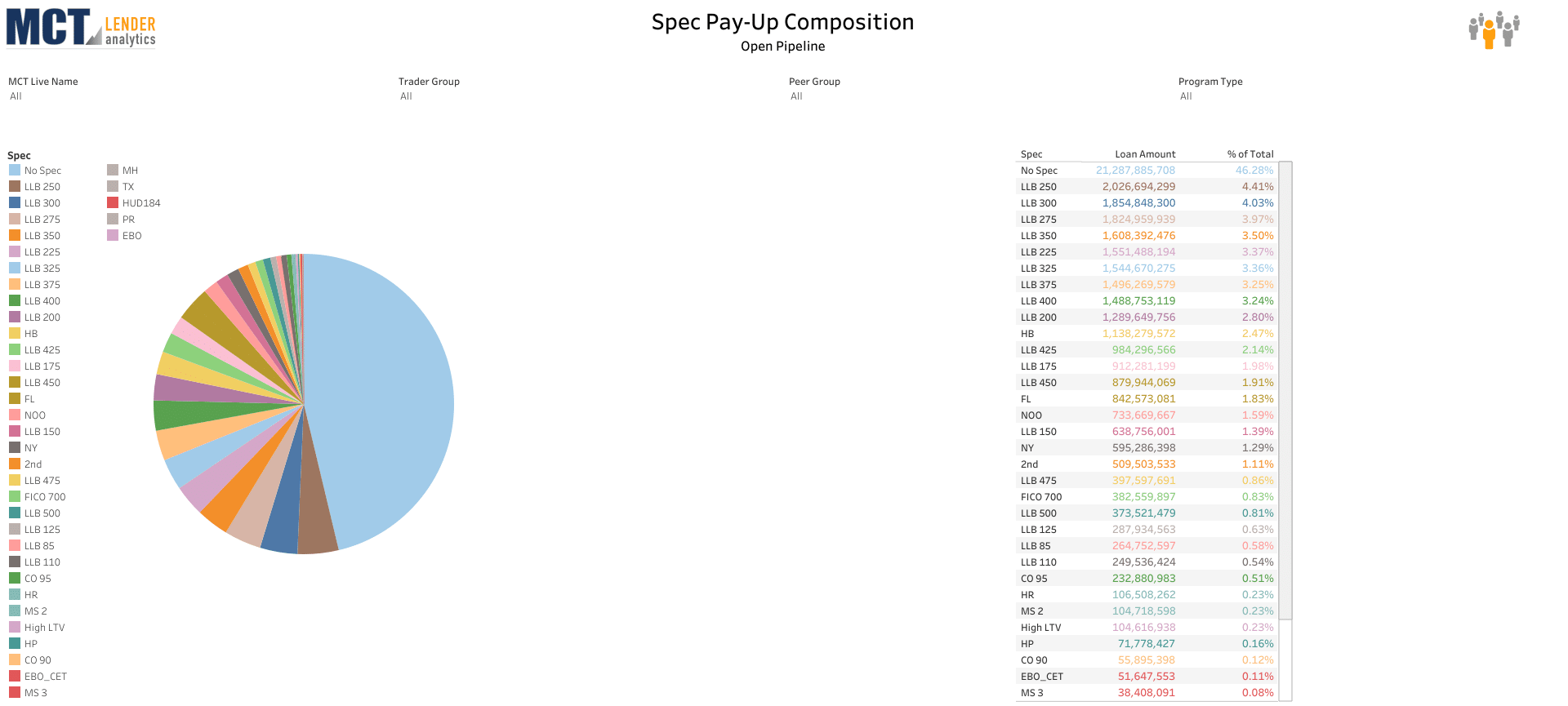
Across MCT client pipelines, 53.72% of loan balance falls into one or more spec stories, meaning more than half of production is exposed to shifts in spec pay-ups.
That share has grown steadily over the past decade as investors have carved out more and more spec stories they are willing to pay up for.
When over half of production moves with spec pay-ups, tracking those pay-ups, and monitoring how much of the premium actually passes through to front-end pricing, becomes essential.
There’s a direct impact for lenders passing those pay-ups through. If front-end pricing doesn’t move with the market in real time, the rates going out to borrowers are built on premiums that no longer exist at sale, and every affected loan sells for less than the pricing implied.
“Especially during times of market volatility, it’s important to keep a close eye on front-end pricing, including any spec pay-ups that are being passed through,” Sarah explains.
How Spec Pay-ups Flow Through to Borrower Pricing
Spec pay-ups are the price premium investors pay for loans and pools with specific characteristics, typically because those loans carry slower prepayment risk.
“The most common pay-ups are for loans with low loan balances. Many lenders pass along some of the spec pay-ups in their front-end pricing, so it’s important to keep an eye on these to make sure pricing is in line with the market and not too strong or too weak.“
Front-end pricing changes daily, and the chain from a secondary market movement to a borrower’s rate sheet is shorter than many lenders assume.
“Spec pay-up shifts are observed by comparing spec rate sheet pricing versus non-spec pricing, or versus market movement,” Sarah explains. “We typically look at Fannie Mae and Freddie Mac rate sheets to observe these shifts.”
When those relationships move, the pricing a lender can achieve at loan sale moves with them, effectively in real time.
That immediacy is what makes the pass-through decision consequential:
- The impact is instant. “These changing specs will instantly affect the pricing that’s achievable when loans are sold, so it’s important for lenders to react quickly if they’re passing any of these pay-ups along in front-end pricing,” Sarah explains.
- Lenders with varying pricing strategies are exposed too. “Many aggregator rate sheets break out higher pricing for different spec stories, so keep in mind it affects lenders who price using best efforts rate sheets,” Sarah notes.
Who owns the call to pass pay-ups through depends on the lender’s pricing strategy:
- Agency-based pricing: pass through a set percentage of the spec into front-end pricing.
- Best efforts aggregator pricing: exposure depends on which aggregators a lender uses, since some break out specs and others don’t. Today the majority of aggregators do offer spec pay-ups in their best efforts rate sheets.
In most lender shops, the capital markets professional is the person setting front-end pricing and margins, which makes this a manual, hands-on decision that needs to happen in real-time.
What Lenders Get Wrong When Pay-ups Shifted
If a lender is setting margins based on instinct or last quarter’s data, they’re already behind.
Two mistakes show up again and again when spec pay-ups move. Either passing along too much in front-end pricing or not using data for peer context.
Speed compounds both problems. Because spec changes hit executable pricing immediately, a slow reaction during a volatile stretch is the difference between protecting margin and giving it away loan by loan.
It also leaves originators without the data to determine whether a competitor’s pricing is better or the insights needed to explain pricing differences to borrowers.
Passing Along Too Much Through Front-End Pricing
“Spec pay-ups can be very volatile, so it would be a mistake to pass along 100% of them in front-end pricing,” Sarah explains.
MCT’s Base Rate Generator applies spec percentage holdbacks so lenders can pass pay-ups through intelligently rather than in full.
When a lender passes pay-ups through and does not react to a drop like March 2026, the result is predictable. “Their front-end pricing would be stronger than the final sell pricing that’s executable, and their profits will drop,” Sarah explains.
No Data-Driven Decision Making
Without visibility into where their spec pay-ups sit relative to peers, lenders lose a valuable read on the broader market.
“Seeing what pay-ups are among peers can give lenders better insight into what the broader market of spec looks like and how much competitive pressure exists to pass pay-ups through,” Sarah explains.
How Lender Analytics Advanced Solves the Pay-up Problem
Stop setting margins by instinct.
With Lender Analytics Advanced, rather than recalculating spec pay-ups from rate sheets by hand every morning, capital markets teams get a read on how their borrower pricing compares to the market and what moving the margin would cost or gain them in volume.
It runs on the largest buyer and seller secondary market dataset available, sourced from MCT client locks and deliveries rather than surveyed, modeled, or third-party aggregated data.
“Calculating out the spec pay-up amounts from rate sheets each morning is a tedious, time-consuming task. Our platform takes care of that work, as well as providing data across peers for a better overall market view.”
Three views connect directly to the March 2026 scenario.
Front-End Pricing Workbook
Once lenders know how spec pay-ups have shifted, the next question is how much of that movement to pass through to borrowers. This is the data loan originators are asking for, and the answer to whether their concerns are justified.
Lender Analytics Advanced’s Front-End Pricing shows exactly where a lender is priced above or below market by note rate, and puts a number on what a margin change would mean for volume.
It answers the question every capital markets manager asks, ‘If I change my margin, what happens to my market share?’
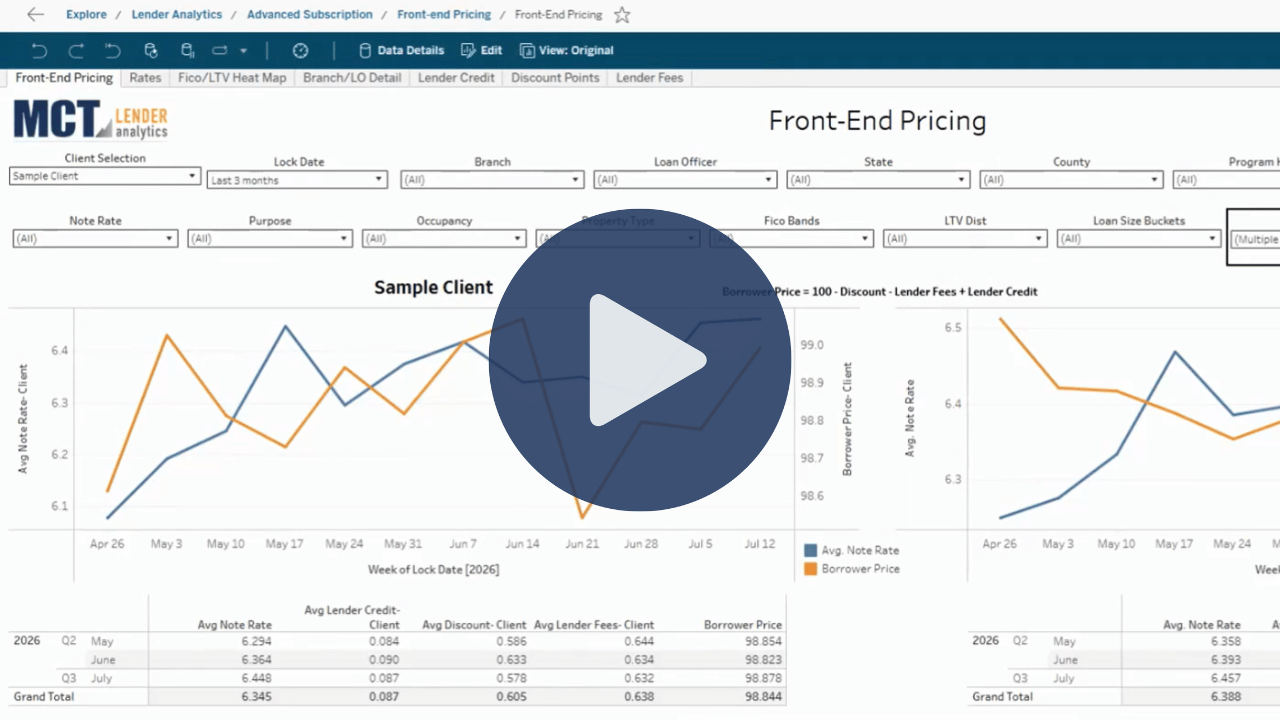
- What it shows: Discount points, lender credits, and lender fees collected from MCT’s client base, normalized to a true borrower price and broken out by note rate. Filtering options include LLB loan size buckets and state.
- Why it mattered in March 2026: After the drop-off, lenders with access to this data could compare their note rates to peers and see exactly how competitors were structuring the full borrower price around them.
“Discount points, lender credits, and lender fees are all surfaced, normalized to a true borrower price, so lenders aren’t just comparing rates in isolation,” Sarah explains. “They’re seeing the complete picture of how competitors are pricing for the same borrower. That context turns a spec pay-up decision into a front-end pricing strategy.”
“For lenders passing along a considerable portion of the spec pay-ups into their front-end pricing, it would be prudent to analyze this data every morning,” Sarah continues. “If spec values are showing a drop, the lender may want to hold back a larger percentage of what’s being passed through in their front-end pricing.”
Spec Pay-Up Trends
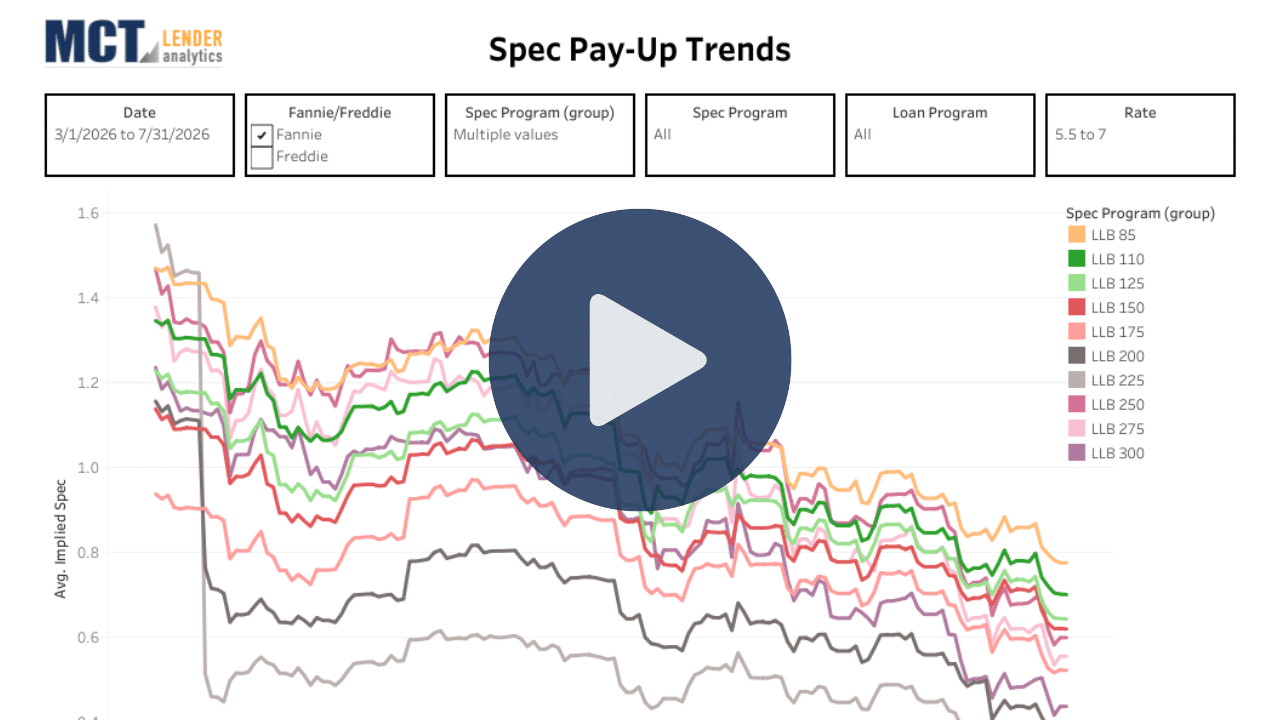
When spec pay-ups shift, there’s a window and a cost. The Spec Pay-Up Trends dashboard shows current pay-up values across the market so lenders know exactly how much to pass through to front-end pricing before they either leave margin on the table or price themselves out of a loan.
- What it shows: Values are derived by looking at Fannie Mae and Freddie Mac rate sheets and calculating the difference between the spec program and non-spec pricing. Filtering options include program and note rate.
- Why it mattered in March 2026: A lender watching this view would have seen the LLB pay-ups compress as it was happening, not weeks later at month-end.
Spec Composition of Open Pipeline
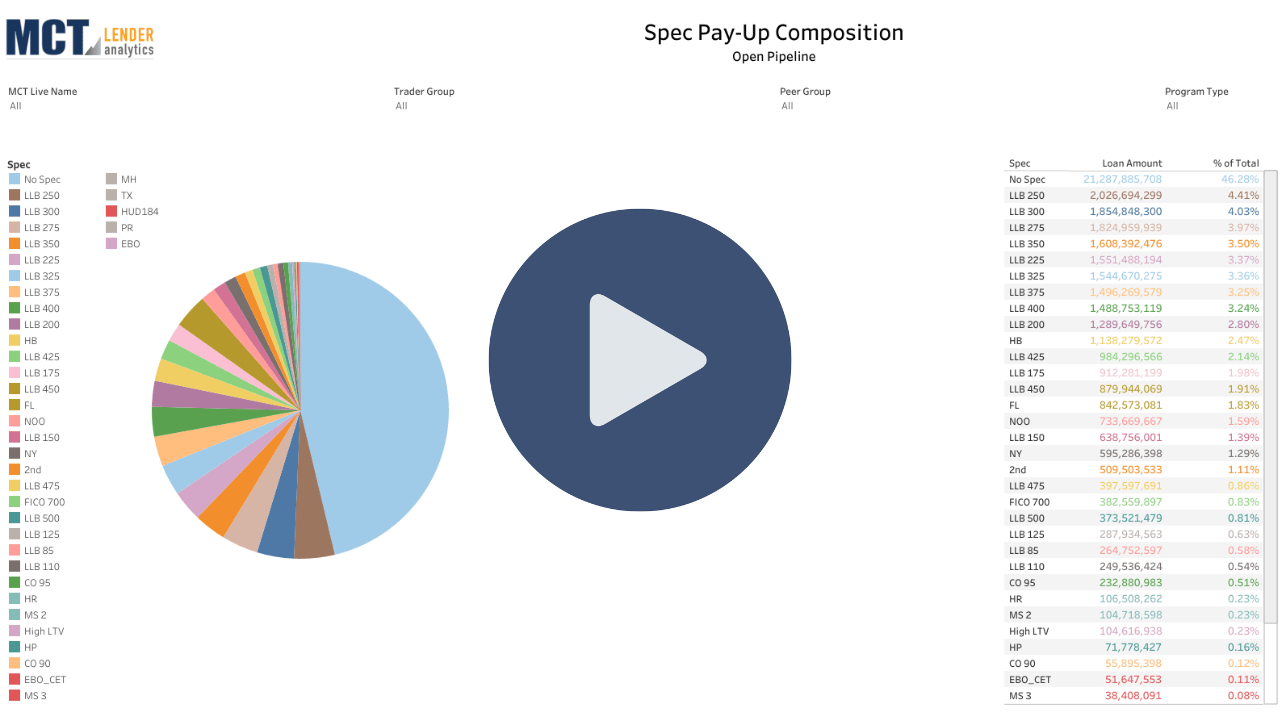
Knowing that pay-ups moved is only half the picture. This view shows how much of a lender’s own book is exposed.
- What it shows: The composition of the lender’s current hedged pipeline in terms of what spec versus non-spec loans they have.
- Why it mattered in March 2026: When pay-ups compressed, lenders with this view could immediately quantify exactly what percentage of their hedged pipeline was affected and turn a market headline into a specific, actionable number on their own book.
Learn More About Lender Analytics Advanced
The March 2026 spec pay-up drop-off showed how quickly these premiums can compress and how easily that movement slips past a lender until it shows up on the P&L.
Especially during volatile stretches, front-end pricing and any pay-ups passed through it deserve daily attention. Lender Analytics Advanced gives capital markets teams the spec trends, pipeline exposure, and peer pricing benchmarks to see those moves as they happen and adjust with confidence.
See the spec intelligence tools in action. Request a walkthrough of Lender Analytics Advanced today.