

Join our newsletter to receive every MSR update!
MBA’s application survey showed a sharp increase in mortgage rates; the Conforming 30-year contract rate reached 6.97% for the week ending September 11, its highest level since May 2025. MBA attributed the increase to high energy prices, persistent inflation, monetary-policy uncertainty and the 10-year Treasury yield moving above 5%. MBA’s conclusion from its July/August report is that the mortgage market is no longer merely pricing “higher for longer”. It is increasingly pricing the possibility of “higher from here”.
The MSR market, on the other hand, continues to benefit from a favorable prepayment environment but exposed to an increasingly complicated credit and valuation environment. Higher rates are extending projected servicing duration periods and suppressing refinance-driven CPRs (constant prepayment rate), but housing turnover remains close to historic lows, FHA credit performance warrants closer attention, and Treasury volatility all increasing MSR duration and hedging risk. The MSR narrative has changed as well, instead of waiting for rate cuts, markets are increasingly debating whether the Fed may need to raise rates again to address persistent inflation.
Economic data produced an unusual combination of resilient growth, stronger employment, and persistent inflation. August payrolls increased by 162,000, substantially exceeding expectations. This development contributed to higher Treasury yields and increased expectations for several future Fed tightening moves. While at the same time, inflation accelerated. August CPI was four times July’s pace at 0.4% month over month, while year over year inflation remained at 3.4%.
The recent economic results are unfortunately problematic for mortgages. The combination of August’s economic data is becoming more important than the traditional assumption that slower housing activity will automatically produce lower mortgage rates.
Economists continue to sound the alarm; they are concerned if equities and corporate earnings can remain strong while households, housing and interest rate sensitive sectors struggle. Economists also caution that growing government debt, corporate capital requirements and potentially reduced foreign demand for Treasuries could keep long-term rates elevated even when the Fed has the flexibility on short-term rates.
The MSR Asset implications can be significant; MSR holders should operate with the assumption that long-term Treasury yields could remain elevated even if economic growth eventually slows. This assumption supports maintaining a wider possible rate fluctuations in MSR valuation rather than assuming mean reversion towards a 5% mortgage rates.
Housing market conditions weakened further during August; August existing home sales fell 2.0% to a 3.98 million annualized pace, the lowest level in 14 months. Sales were also 1.2% below the prior year. Inventory, however, increased by 3.2% month over month and 5.9% year over year to 1.62 million homes, the highest level since November 2019.
New Production and Value Trends:
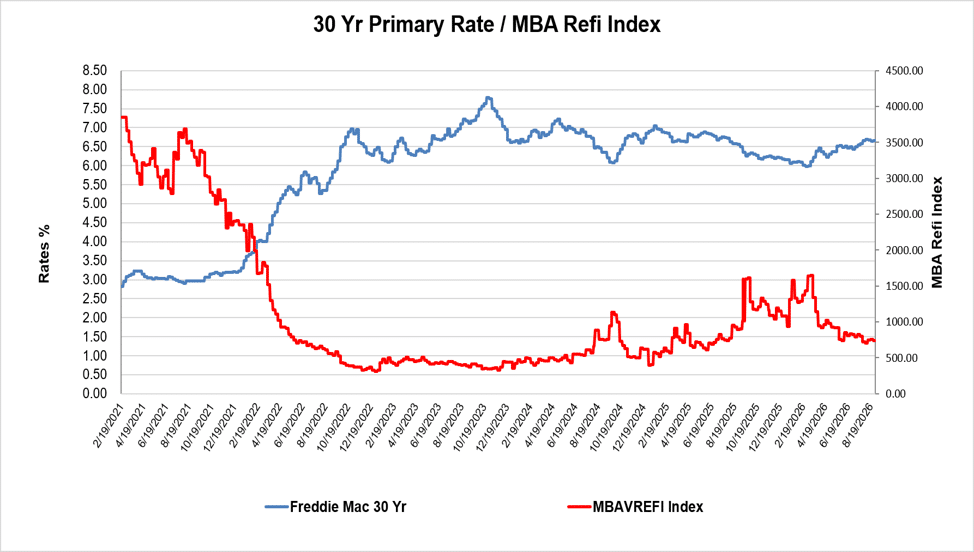
Mortgage refinance activity deteriorated substantially as rates approached 7%. The MBA specifically noted that the increase in rates eliminated the refinance benefit for many conventional, FHA, and VA borrowers. For MSR modeling, this is significant evidence supporting continued suppression of refinance driven CPR.
At the time of this publication, the refinance share of applications totaled 39.4%. Which represents a 65% year over year decline.
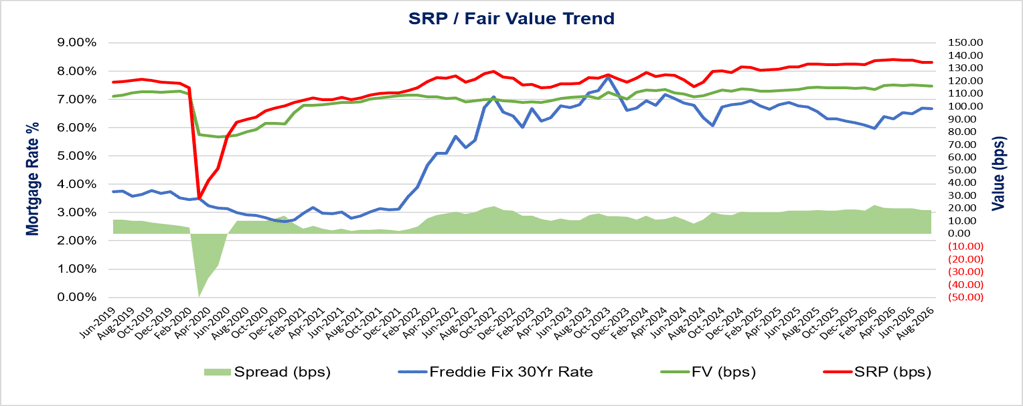
The current average SRP levels have remained relatively flat since our market update, leading to a slight tightening of the spread between fair value and SRP. The current spread between fair value and SRP is generally about 12-17 basis points, depending on the underlying portfolio characteristics. We continue to advocate for caution when capitalizing new MSR production at moderate price levels as current SRP levels reflect the aggregator’s economies of scale rather than actual fair value.
Bulk MSR Market
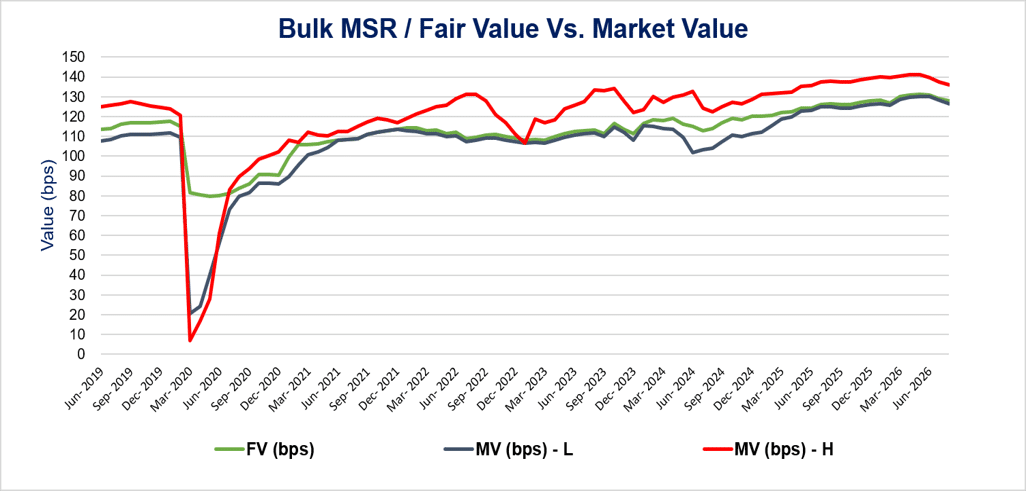
Bulk MSR trades continue their downward trend as buyers and sellers assess Treasury yields and mortgage rates levels and their potential impact on MSR values and related hedging risks.
Bulk MSR prices remain strong and recent trades commanded price levels ranging from 4.50x – 5.50x for Conventional products. Government MSRs with no delinquency and WACs below 5.50% continue to trade between 3.75x and 4.00x multiples of servicing fees. Moderately seasoned conventional loan vintages from 2024 and 2025 are trading between 4.25x and 4.50x multiples of servicing fees.
MSR Buyer appetite is resilient, but currently more cautious. MCT anticipates normal and continuous trades through the remainder of 2026.
Non-QM and Second Mortgages Trends
Non-QM and HELOC originations remain one of the stronger areas of the broader mortgage market. Demand for Non-QM continues to rise month after month and remains one of the brightest spots in the current market. DSCR production remained solid, however investors have become more selective. The most significant finding that MCT has experienced within the Non-QM valuation analysis is the performance variation by documentation type; DSCR/Full doc loans are performing much better than self-employed borrowers. Non-QM remains a relatively slow prepay asset but the credit differentiation between DSCR/Full-Doc and self-employed borrowers is becoming increasingly important to monitor.
HELOC and second-lien economics remain compelling because the first-mortgage lock-in effect has further strengthened. The economics of refinancing a 3%-4% first mortgage faces little or no incentive to replace the entire balance with a mortgage rate now approaching 7%. Consequently, borrowers requiring additional liquidity continue to have a strong incentive to preserve the first lien and leverage HELOC or closed-end-second mortgage instead.
According to the MBA, overall mortgage credit availability fell 1.0% in August, with lenders specifically reducing flexible-documentation and cash-out refinance programs. This should continue directing some equity extraction toward second liens rather than first-lien cash-out refinancing.
MCT anticipates that Non-QM loan pricing will remain stable and steadily rise over the course of the year. The bulk MSR market for these two segments remains virtually nonexistent. Underlying fair values for Non-QM MSR products remain between 3.50x and 4.00x multiples of servicing fees, while fair values for second-mortgage and HELOC MSR products are between 2.25x and 3.25x multiples of servicing fees.
Did you know MCT offers non-qm portfolio valuations? Contact the MSR team today to learn more or schedule a consultation.
Mortgage Rates
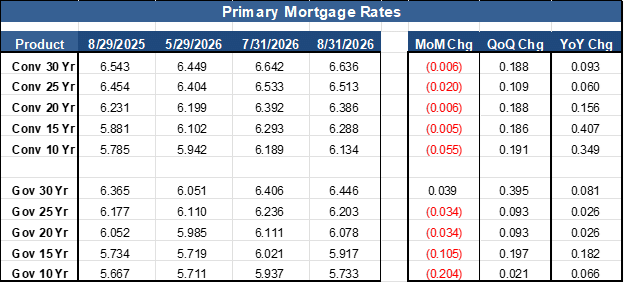
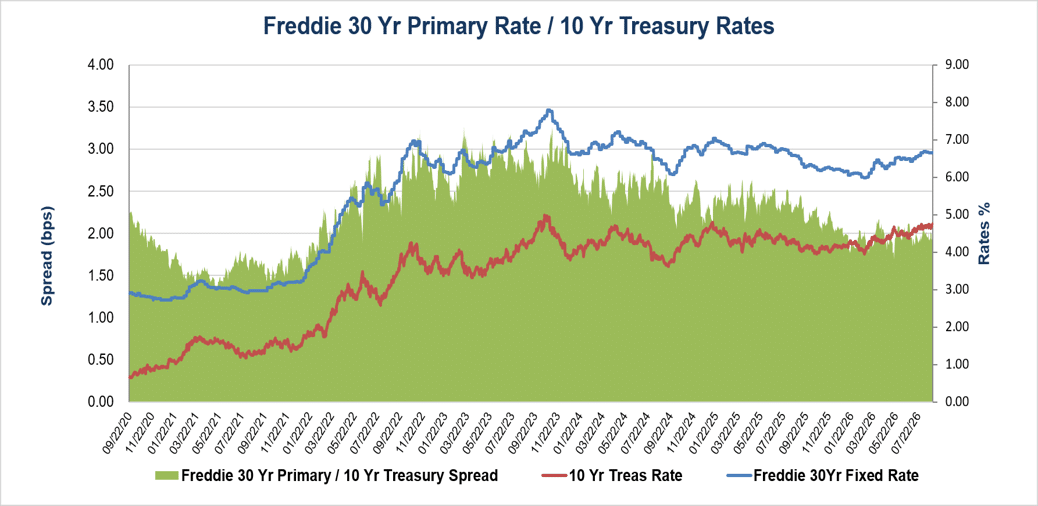
The market consensus continues to expect mortgage rates to remain in the 6.50%-7.00% range over the near term, with any meaningful decline likely requiring sustained improvement in inflation, a softer labor market, and lower Treasury yields.
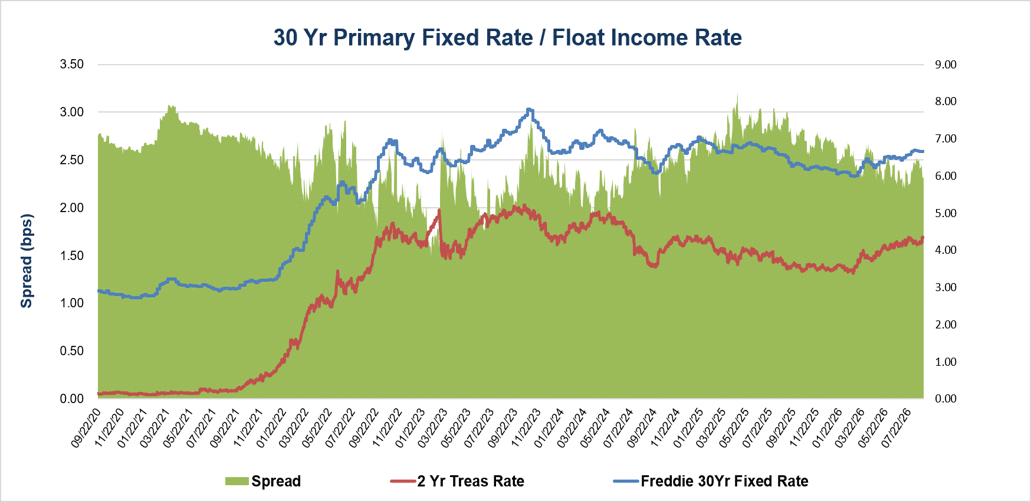
As of August 31, 2026, the current fixed 30-year mortgage rate is 6.636%, which is relatively flat since July 31, 2026, mark.
Escrows and Float Income
Mortgage escrow values rose from the July 31, 2026, mark due to a five (5) basis point increase in the float income rate. Note: Escrow float income value is the second-largest contributor to the overall MSR value.
Rates Indices
Mortgage rates have remained relatively unchanged from their July 31, 2026, levels. MCT’s August 31, 2026 primary 30-year fixed mortgage rate was at 6.6364%.
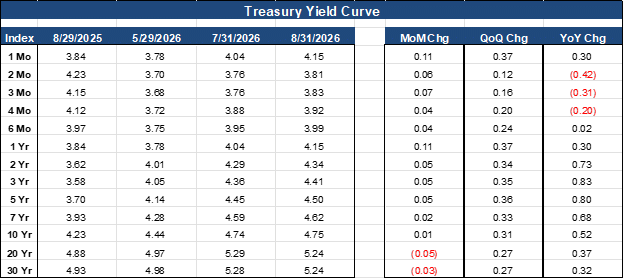
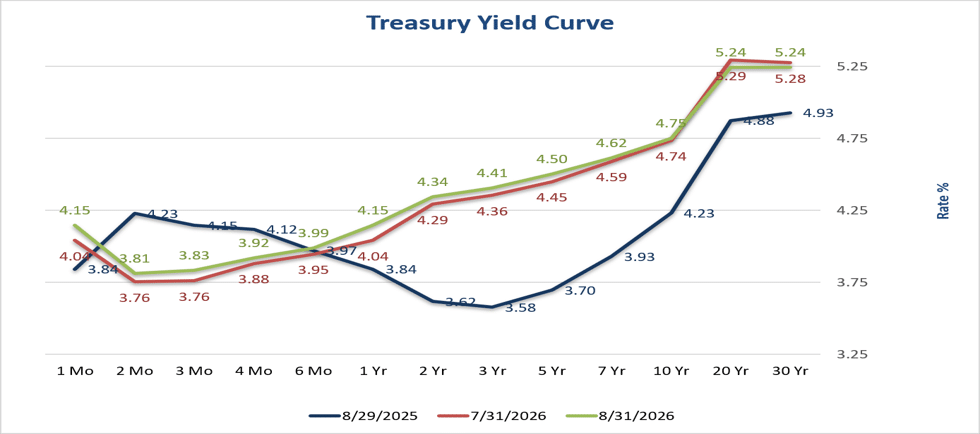
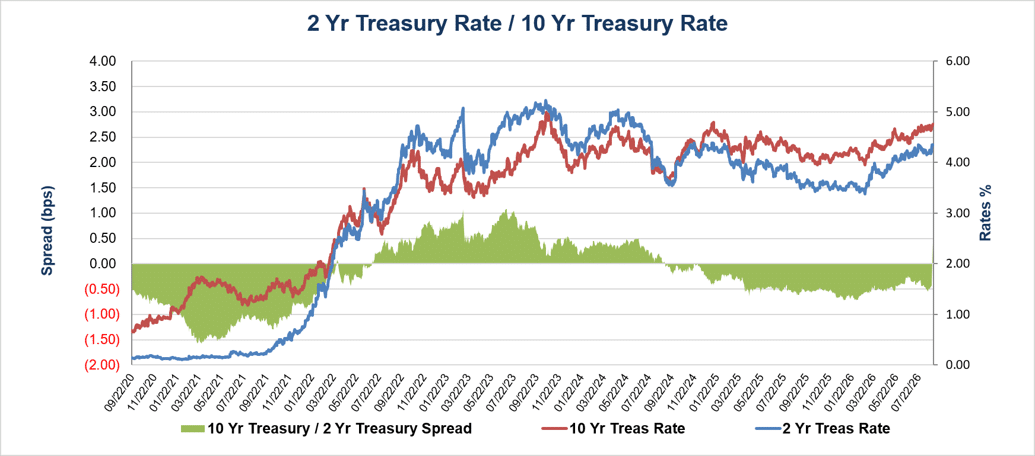
The current Treasury Yield Curve continues to reflect economic distress and future economic and geopolitical uncertainties.
As of August 31, 2026, the yield on the benchmark 10-year Treasury is 4.752%, representing about a one (1) basis point increase from the prior month. The current yield curve continues with its flattening trend due to inflation, economic concerns, and geopolitical risks.
Fair Value Guidance
Our August 31, 2026, fair value guidance for existing portfolios should reflect a slight increase in value from their July 31, 2026, marks due to a slight increase in mortgage rates and improved float income rates. Most MSR owners should expect an increase of less than one basis point, depending on the level of escrows within the portfolio.
MSR holders should expect a maximum change in values ranging between +1 and +2 basis points.
For portfolios that have a mix of Conventional and Government loans, we anticipate Fair Value changes as follows:
- Conventional loans between +0 to +2 bps change from July 31, 2026, marks.
- Government loans between +0 to +2 bps from July 31, 2026, marks.
If you have any questions or would like to schedule a call with our MSR team, please contact us today.
About MCT: For over two decades, MCT has been a leading source of innovation for the mortgage secondary market. Melding deep subject matter expertise with a passion for emerging technologies and clients, MCT is the de facto leader in innovative mortgage capital markets technology. From architecting modern best execution loan sales to launching the most successful and advanced marketplace for mortgage-related assets, lenders, investors, and network partners all benefit from MCT’s stewardship. MCT’s technology and know-how continues to revolutionize how mortgage assets are priced, locked, protected, valued, and exchanged – offering clients the tools to thrive under any market condition.
For more information, visit https://mct-trading.com/ or call (619) 543-5111.
Media Contact:
Ian Miller
Chief Marketing Officer
Mortgage Capital Trading
619-618-7855
pr@mctrade.net