

Join our newsletter to receive every MSR update!
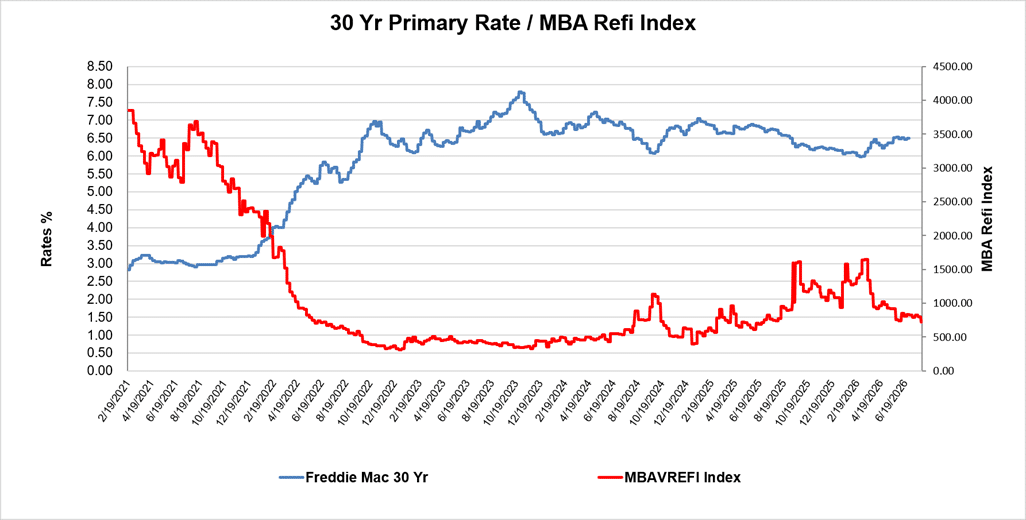
The mortgage market deteriorated modestly during the latter part of July as higher Treasury yields, persistent inflation concerns, and geopolitical and energy market risks pushed mortgage rates towards the highest levels of the year. Freddie Mac’s weekly 30-year fixed rate clearly shows rising rates progression. The rate reached 6.55% in mid-July and remained above 6.60% through August 20. The 30-year rate was 6.65% versus 6.58% a year earlier. The current mortgage rate level leaves the market substantially less supportive of purchase and refinance activity than it was during the first half of 2026.
The economy continues to grow, but momentum is slowing, with consumer spending providing much of the support. The labor market is becoming the most important counterweight to inflation. Payroll employment fell by 23,000 in July, following downward revisions to June, while private-sector employment increased only modestly. Economists are concerned that both labor demand and labor supply are weakening, which is a difficult combination for the Fed because inflation remains elevated even as employment conditions deteriorate.
The important change from our previous MSR announcement is that the downside risk to rates has increased rather diminished. Inflation has moderated somewhat; July CPI increased by only 0.1% month over month and was 3.4% year over year, but the improvement has not been sufficient to eliminate concerns about renewed inflation from energy, tariffs, and supply side pressures. Some economists characterize the current environment as particularly difficult for the Fed because inflation pressures remain while the labor market is weakening. At the same time, Fed minutes released today, August 20 showed a more hawkish debate, with several officials favoring a potential September rate hike.
According to economists, mortgage bankers should not assume that weaker employment automatically produces lower mortgage rates if inflation expectations and Treasury term premiums remain elevated. This is a very important point when considering MSR valuations and MSR retention strategies. A recessionary slowdown could reduce rates, but an inflationary and geopolitical shock could push rates higher while economic growth weakens.
The housing market weakened noticeably as mortgage rates moved higher. July housing data showed that Single Family housing starts fell by 9.9% month over month and 15.7% year over year. Buyer demand had fallen to its lowest level since March; Home inventory is improving, but demand is weakening faster. That should gradually improve buyer negotiating power and increase price concessions, particularly in higher inventory markets.
New Production and Value Trends:
Mortgage refinance activity has remained weak and became increasingly rate sensitive. The Refinance share of applications has declined by almost 50% from their peak in March. The key structural issue is the mortgage rate lock-in effect. Millions of homeowners continue to have first mortgages at rates materially below today’s 6.5% - 6.7%. Rate/Term refinancing remains limited while cash-out refinancing remains selective. Home equity and closed-end seconds remain attractive alternatives.
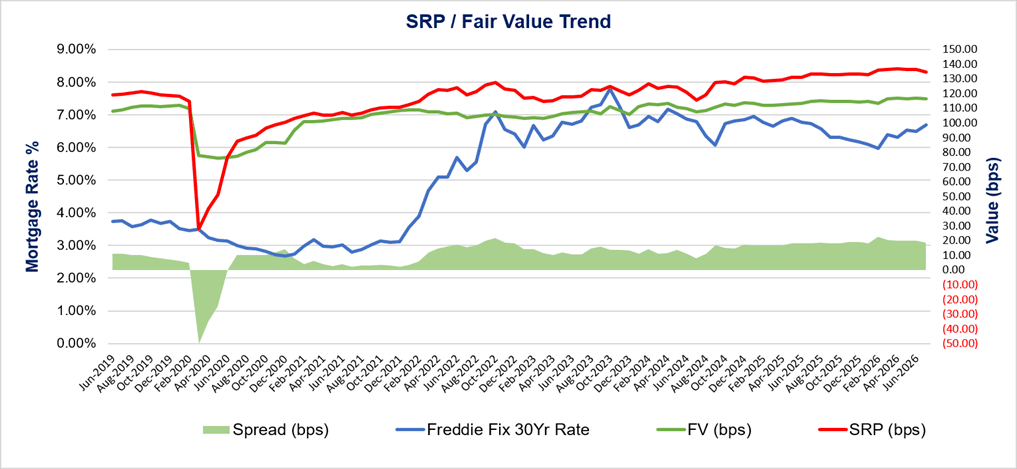
Current servicing released premiums (SRP) remain strong as major aggregators continue to offer record SRP prices, including FHA production. But we are also observing a slight pullback in the overall SRP price as Treasury yields continue to rise. The current average SRP levels have remained relatively flat since our last report, leading to a slight tightening of the spread between fair value and SRP. The current spread between fair value and SRP is about 12-15 basis points. We continue to advocate for caution when capitalizing new MSR production at moderate price levels as current SRP levels reflect the aggregator’s economies of scale rather than actual fair value.
Bulk MSR Market
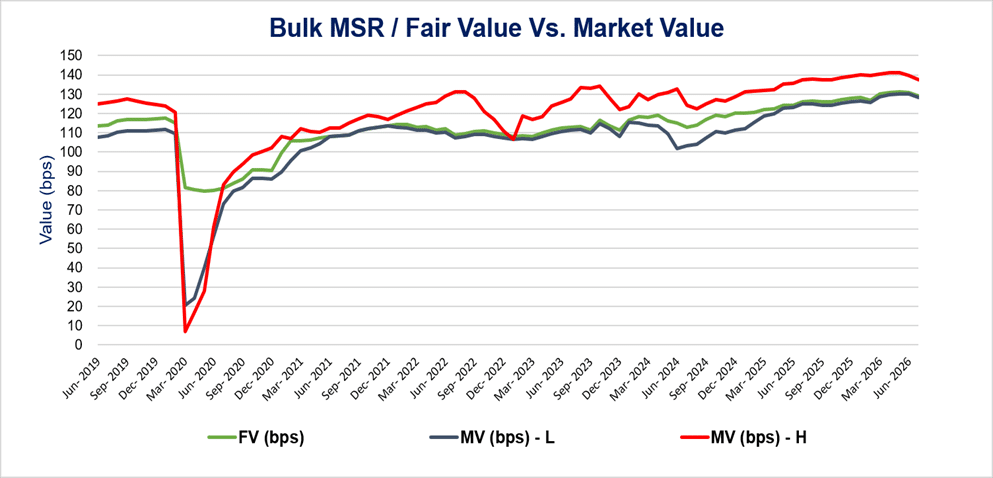
Bulk MSR trades have slowed down during July as buyers and sellers are being more cautious as rates continue to rise and the market experiences a number of economic uncertainties. MCT anticipates normal and continuous trades through the remainder of 2026, many are expected to be direct trades. Bulk MSR portfolios continue to trade at servicing fees multiples between 4.50x and 5.25x of servicing fees. Government MSRs with no delinquency and interest rates below 5.50% continue to trade between 3.75x and 4.00x multiples of servicing fees. Newer conventional loan vintages from 2024 and 2025 are trading between 4.25x and 4.50x multiples of servicing fees.
Non-QM and Second Mortgages Trends
This remains one of the stronger areas of the mortgage market. Demand for Non-QM continues to rise month after month and remains the brightest spot in the current market. DSCR production remained solid, however investors are being more selective. DSCR loans continued to outperform owner-occupied alternative documentation products. Bank Statement loans exhibited modest softening but remained well within investor expectations.
HELOC and second-lien demand remained elevated as homeowners increasingly chose to preserve low-rate first mortgages while accessing accumulated home equity. ICE reported that Q1 2026 second-lien lending reached its strongest first-quarter volume in nearly two decades, with 54% of equity extraction occurring through second liens. According to the report, nearly 3.9 million borrowers who originated first mortgages during 2020-2022 have subsequently added a second lien. This trend is likely to remain structural until first mortgage rates decline substantially.
This is important because increased second-lien penetration can potentially reduce future cash-out refinance demand while increasing borrower leverage and altering prepayment and default behavior.
Non-QM performance remains generally stable, but performance is increasingly differentiated by product; Higher DTI and lower Credit Score loans have the greatest risk. MCT anticipates that Non-QM loan values will remain stable and steadily rise over the course of the year. The bulk MSR market for these two segments remains virtually nonexistent. Underlying fair values for Non-QM MSR products remain between 3.50x and 4.00x multiples of servicing fees, while fair values for second-mortgage and HELOC MSR products are between 2.25x and 3.25x multiples of servicing fees.
Did you know MCT offers non-qm portfolio valuations? Contact the MSR team today to learn more or schedule a consultation.
Mortgage Rates
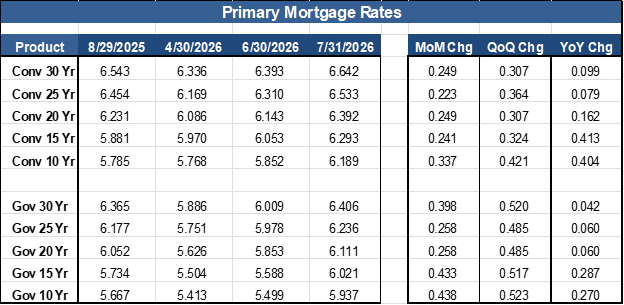
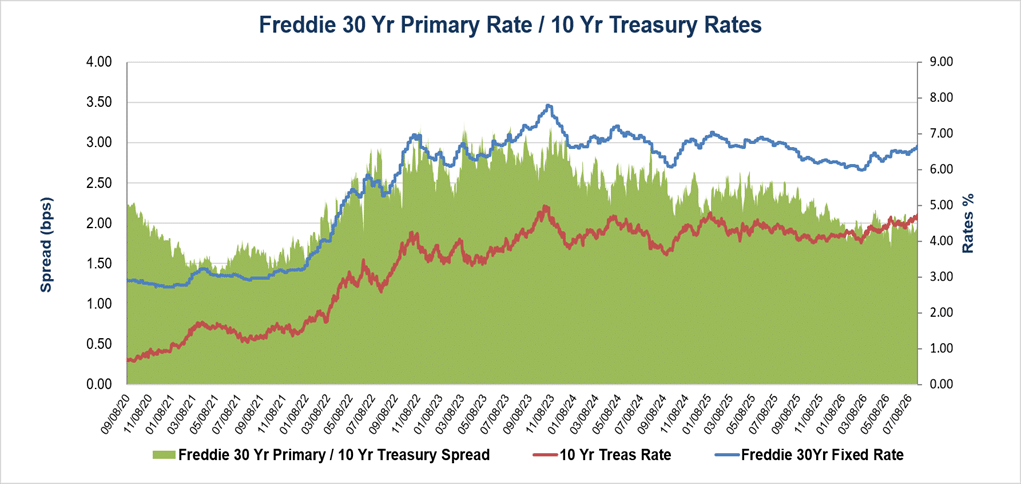
The market consensus continues to expect mortgage rates to remain in the 6.40%-6.80% range over the near term, with any meaningful decline likely requiring sustained improvement in inflation, a softer labor market, and lower Treasury yields. As of July 31, 2026, the current fixed 30-year mortgage rate is 6.6423%, which represents a 24.9 basis points increase from the June 30, 2026, mark.
Escrows and Float Income
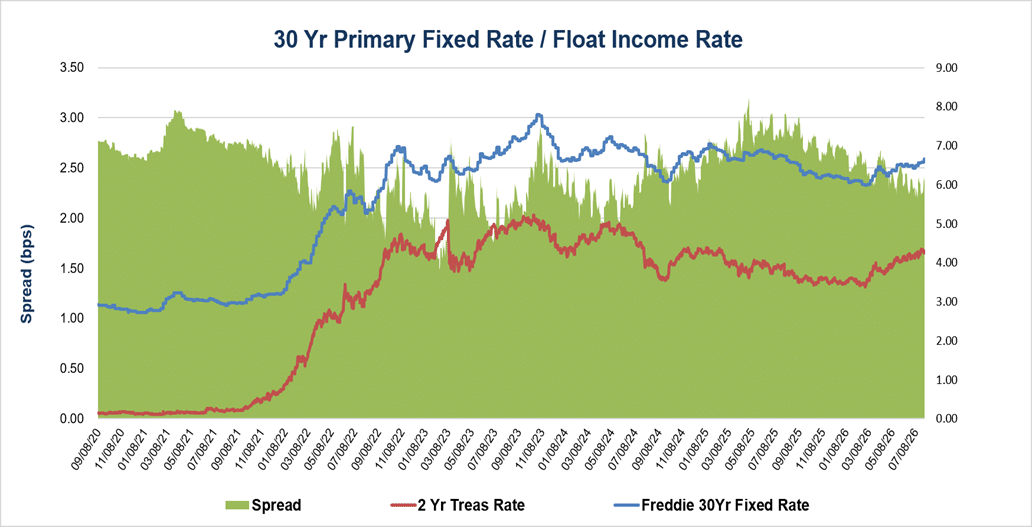
Mortgage escrow values rose from the June 30, 2026, mark due to a 12 basis points increase in the float income rate. Note: Escrow float income value is the second-largest contributor to the overall MSR value.
Rates Indices
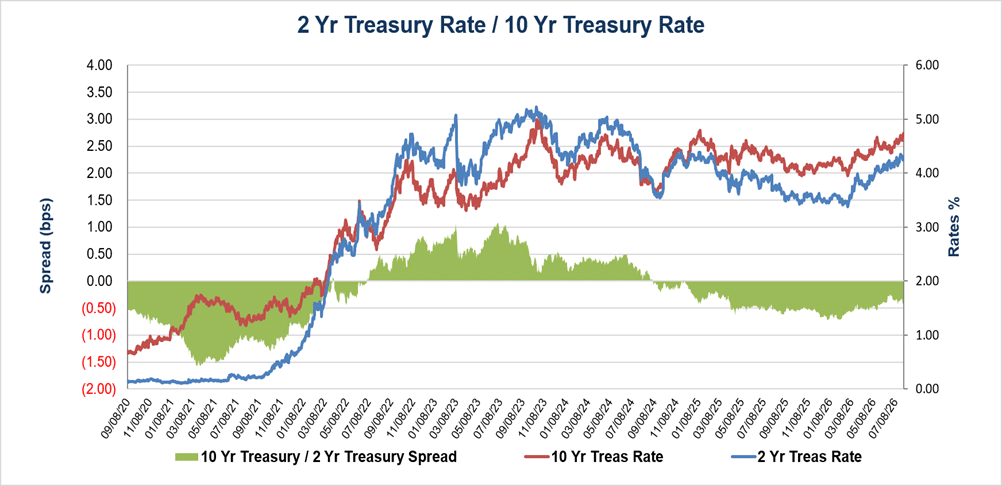
Mortgage rates have risen sharply from their June 30, 2026 levels. MCT’s primary 30-year fixed mortgage rate increased by 24.9 basis points to 6.6423%. The current Treasury Yield Curve continues to reflect economic distress and future economic and geopolitical uncertainties. As of July 31, 2026, the yield on the benchmark 10-year Treasury is 4.74%, representing a 27 basis points increase from the prior month. The current yield curve remains steep due to inflation, economic concerns, and geopolitical risks.
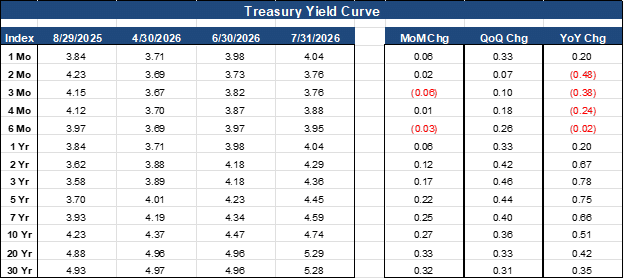
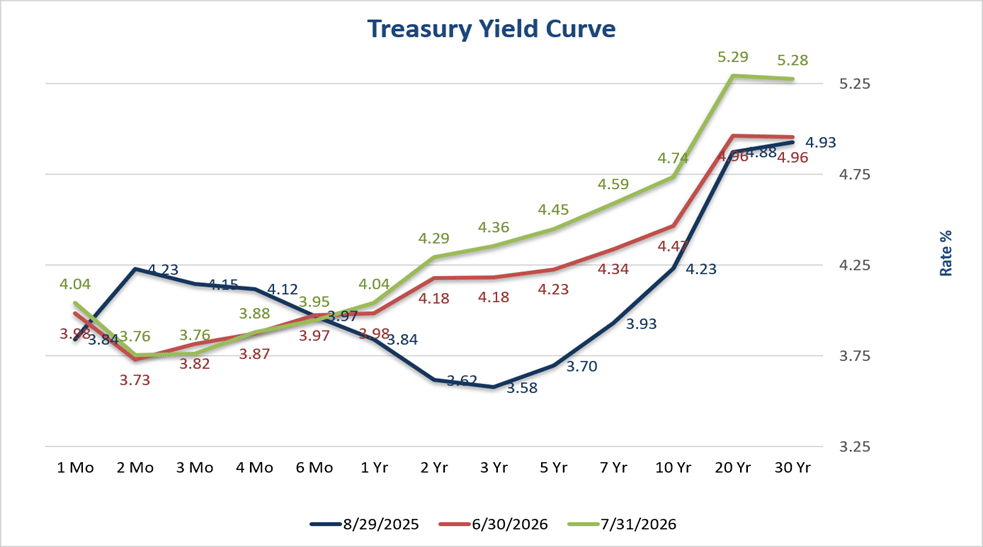
The current spread between the 2 Yr Treasury rate and the 10 Yr Treasury rate is on a trajectory that signals the potential for more economic challenges ahead. The current spread has widened by 15 bps to 44 basis points since June 30, 2026.
Fair Value Guidance
Our July 31, 2026, fair value guidance for existing portfolios should reflect an increase in value from their June 30, 2026 marks due to improved mortgage and float income rates. We anticipate that portfolios with an average interest rate above 6.0% will experience a greater increase in value, ranging between 3 and 5 basis points, while portfolios with an average interest rate below 6.0% will experience a slightly greater increase in value, ranging between 2 and 4 basis points. MSR holders should expect a maximum change in values ranging between +1 and +5 basis points. For portfolios that have a mix of Conventional and Government loans, we anticipate Fair Value changes as follows:
- Conventional loans between +2 to +4 bps change from June 30, 2026,
- Government loans between +2 to +6 bps from June 30, 2026, marks.
If you have any questions or would like to schedule a call with our MSR team, please contact us today.
About MCT: For over two decades, MCT has been a leading source of innovation for the mortgage secondary market. Melding deep subject matter expertise with a passion for emerging technologies and clients, MCT is the de facto leader in innovative mortgage capital markets technology. From architecting modern best execution loan sales to launching the most successful and advanced marketplace for mortgage-related assets, lenders, investors, and network partners all benefit from MCT’s stewardship. MCT’s technology and know-how continues to revolutionize how mortgage assets are priced, locked, protected, valued, and exchanged – offering clients the tools to thrive under any market condition.
For more information, visit https://mct-trading.com/ or call (619) 543-5111.
Media Contact:
Ian Miller
Chief Marketing Officer
Mortgage Capital Trading
619-618-7855
pr@mctrade.net