

Join our newsletter to receive every MSR update!
Mortgage rates have moved higher since our prior reporting period. Freddie Mac’s 30-year fixed mortgage rate increased from 6.49% in late June to 6.55% by July 16, while MBA’s survey showed the average conforming 30-year mortgage rate reaching 6.69%, the highest level since August 2025. The primary drivers of the increase in mortgage rates are stronger-than-expected employment data, higher Treasury yields, higher oil prices, and increasing market expectations that the Federal Reserve will keep rates elevated for longer. Some economists are even discussing the possibility of additional tightening should inflation reaccelerate.
The U.S. economy continued to demonstrate resilience despite higher borrowing costs. The labor market remains healthy, and consumer spending continued to support economic growth. However, the economy remains vulnerable to inflation surprises, particularly those driven by energy prices. Some economists remained cautiously optimistic regarding the economy while acknowledging increasing downside risks.
The housing market remained stable but subdued. Housing inventory continued to increase nationally, and buyers continued to gain additional negotiating leverage. Home price appreciation slowed to low single-digit annual growth. Builder incentives, including mortgage rate buydowns, remained common, but are not as generous as they used to be.
New Production and Value Trends:
Mortgage refinance activity has remained weak since our prior reporting. MBA weekly surveys show that refinance applications fluctuated modestly week to week but remained well below historical averages. Year over year refinance activity remained slightly positive only because 2025 volumes were exceptionally depressed. Cash-out refinancing and home equity loans continued to account for much of refinance demand.

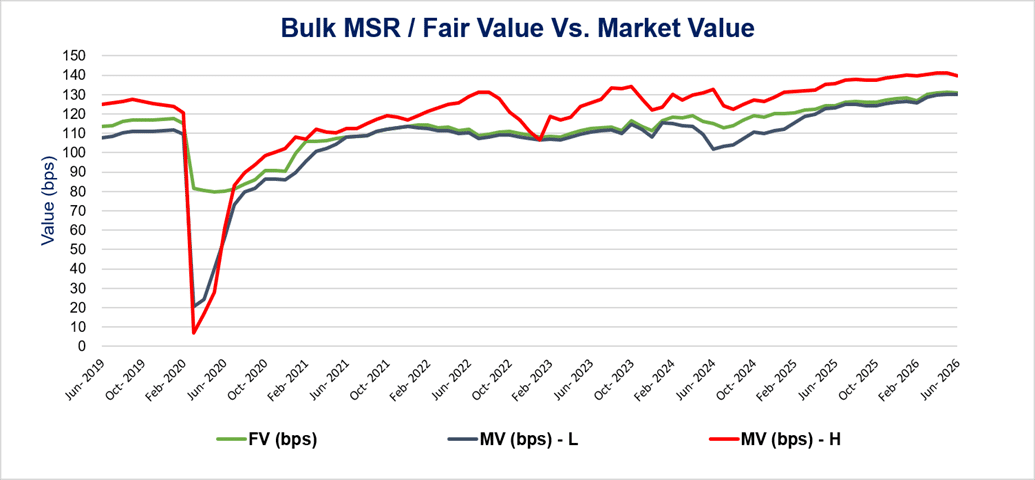
The current average SRP levels have remained relatively flat since our last reporting, leading to a slight tightening of the spread between fair value and SRP. The current spread between fair value and SRP is about 12-17 basis points. We continue to advocate for caution when capitalizing new MSR production at moderate price levels as current SRP levels reflect the aggregator’s economies of scale rather than actual fair value.

Bulk MSR Market
Several Bulk MSR trades took place during June and early July. Most of the transactions were direct transactions between sellers and buyers. Generally, bulk MSR trades are now a common presence within the industry. MCT anticipates normal and continuous trades through the remainder of 2026.
The MSR market continues to experience some consolidation, which is likely to increase during the remainder of 2026 as the mortgage lending market navigates economic and global uncertainties that could have an impact on the economy.
Bulk MSR portfolios continue to trade at servicing fees multiples between 4.50x and 5.25x. Government MSRs with no delinquencies and interest rates below 5.50% continue to trade between 3.75x and 4.00x multiples of servicing fees. Newer conventional loan vintages from 2024 and 2025 are trading between 4.25x and 4.50x multiples of servicing fees.
Non-QM and Second Mortgages Trends
Non-QM and home equity markets remained relatively resilient. Demand for Non-QM continues to rise month after month. DSCR production remained solid as investors continued purchasing rental properties selectively. Bank statement lending remained stable among self-employed borrowers.
HELOC and second-lien demand remained elevated as homeowners increasingly chose to preserve low-rate first mortgages while accessing accumulated home equity.
Performance remained generally stable. Non-QM prepayments remained driven primarily by investment property transactions rather than refinancing. DSCR and investor loans continued to outperform consumer Non-QM products while bank-statement and higher DTI loans showed modest softening but remained well below historical highs. Strong borrower home equity continued to mitigate loss severity across all loans.
MCT anticipates that Non-QM loan values will remain stable and steadily rise over the course of the year. The bulk MSR market for these two segments remains virtually nonexistent. Underlying fair values for Non-QM MSR products remain between 3.50x and 4.25x multiples of servicing fees, while fair values for second-mortgage and HELOC MSR products are between 2.25x and 3.25x multiples of servicing fees.
Did you know MCT offers non-qm portfolio valuations? Contact the MSR team today to learn more or schedule a consultation.
Mortgage Rates
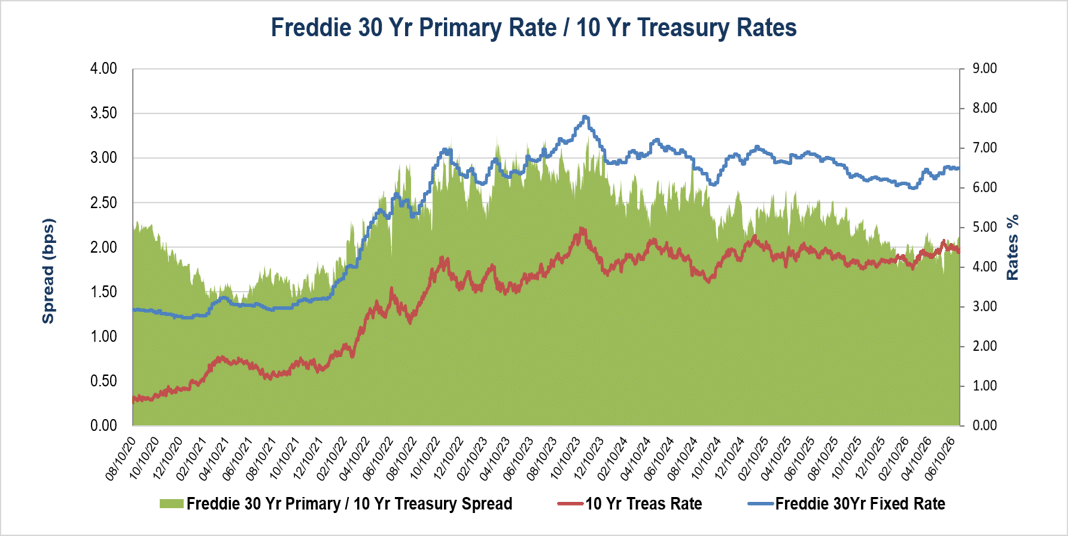
As of July 2026, the market consensus has shifted toward expecting mortgage rates to remain in the 6.40%-6.80% range over the near term, with any meaningful decline likely requiring sustained improvement in inflation and a softer labor market. While the overall economy continues to show resilience, economists highlight growing caution around fiscal deficits, elevated long-term Treasury yields, geopolitical risks, and slowing, but still positive, economic growth.
As of June 30, 2026, the current fixed 30-year mortgage rate is 6.3930%, which represents a 5.60 basis points decrease from the May 31, 2026, mark.

Escrows and Float Income
Mortgage escrow values rose from the May 31, 2026, mark due to a 17 basis points increase in the float income rate. Escrow float income value is the second-largest contributor to the overall MSR value.

Rates Indices
Mortgage rates have decreased from their May 31, 2026, levels. MCT’s primary 30-year mortgage rate decreased by 5.70 basis points to 6.3930%.
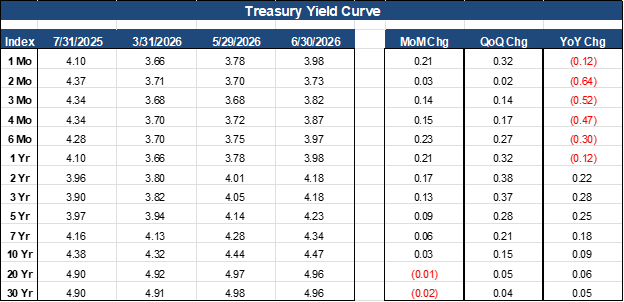
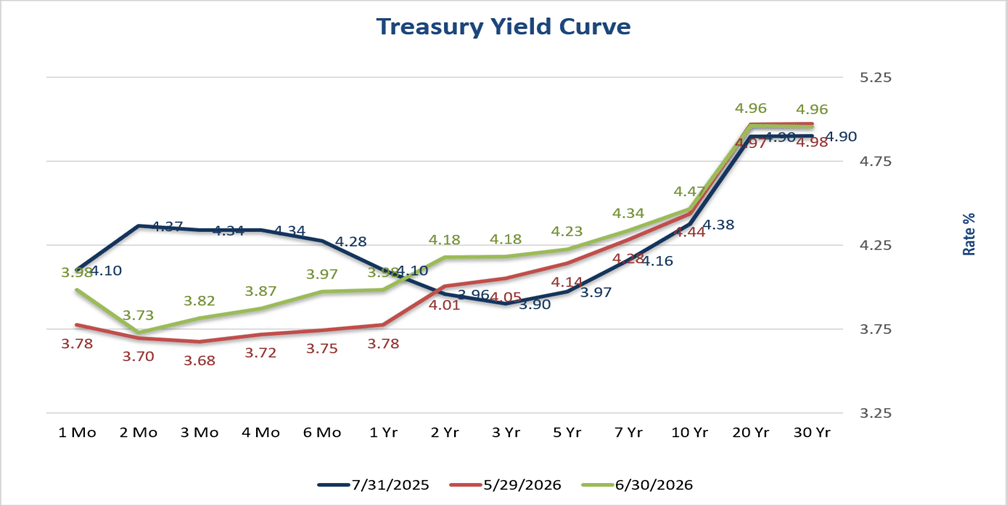
The current Treasury Yield Curve continues to reflect economic distress and future economic and geopolitical uncertainties.
As of June 30, 2026, the yield on the benchmark 10-year Treasury is 4.47%, representing a three (3) basis points decrease from the prior month. The current yield curve remains steep due to inflation, economic concerns, and geopolitical risks.

Fair Value Guidance
Our June 30, 2026, fair value guidance for existing portfolios should reflect a slight increase in value from their May 31, 2026, marks due to improved float income rates. We anticipate that portfolios with an average interest rate above 6.0% will experience a greater increase in value, ranging between 1 and 2 basis points, while portfolios with an average interest rate below 6.0% will experience a slightly greater increase in value, ranging between 1 and 3 basis points.
MSR holders should expect a maximum change in values ranging between +1 and +3 basis points.
For portfolios that have a mix of Conventional and Government loans, we anticipate Fair Value changes as follows:
- Conventional loans between +1 to +2 bps change from May 31, 2026,
- Government loans between +1 to +3 bps from May 31, 2026, marks.
If you have any questions or would like to schedule a call with our MSR team, please contact us today.
About MCT:
For over two decades, MCT has been a leading source of innovation for the mortgage secondary market. Melding deep subject matter expertise with a passion for emerging technologies and clients, MCT is the de facto leader in innovative mortgage capital markets technology. From architecting modern best execution loan sales to launching the most successful and advanced marketplace for mortgage-related assets, lenders, investors, and network partners all benefit from MCT’s stewardship. MCT’s technology and know-how continues to revolutionize how mortgage assets are priced, locked, protected, valued, and exchanged – offering clients the tools to thrive under any market condition. For more information, visit https://mct-trading.com/ or call (619) 543-5111.
Media Contact:
Ian Miller
Chief Marketing Officer
Mortgage Capital Trading
619-618-7855
pr@mctrade.net